1Side-by-side comparison
| Waxed floss | Unwaxed floss | |
|---|---|---|
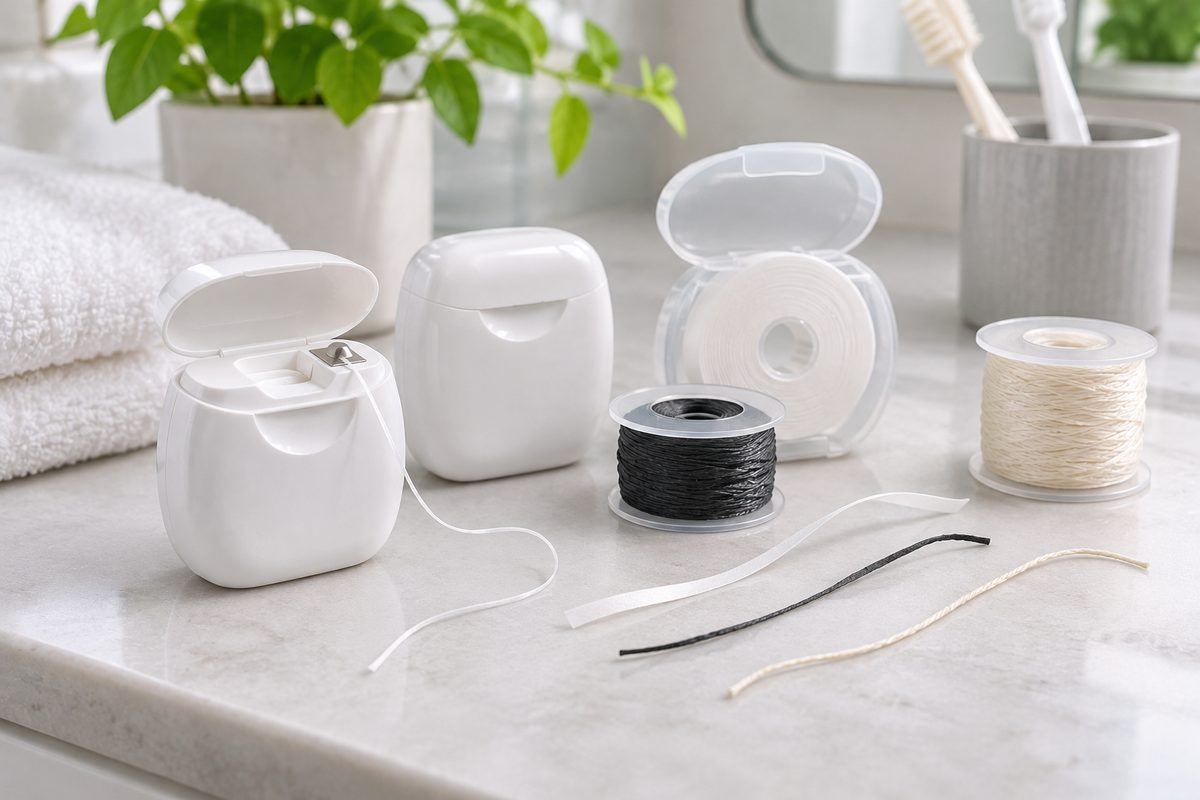
| Construction | Nylon filaments with wax coating | Bare nylon filaments |
| Glide | Easier in tight contacts | More friction |
| Shredding | Less | More, especially on rough edges |
| Thickness | Slightly thicker | Thinner |
| Feedback | Smooth | "Squeaks" on clean enamel |
| Flavours | Often mint | Often unflavoured |
| Plaque removal | Equivalent | Equivalent |
2Which wax is used?
Most waxed floss uses microcrystalline (petroleum-derived) wax; natural lines use beeswax or plant-based candelilla wax for vegan products. The wax is food-grade and present in tiny amounts.
3Is waxed floss bad for you?
No evidence shows waxed floss is harmful. Some consumers prefer to avoid PTFE-coated "glide" floss because PTFE belongs to the PFAS family — that is a material question, not a wax question. See PTFE and PFAS-free floss.
4Which should you choose?
- Tight contacts, crowns or fillings → waxed (or PTFE).
- Prefer thin floss and tactile feedback → unwaxed.
- Braces or bridges → waxed floss with a threader or a woven/tufted floss.
5Waxed floss picks
Floss picks also come with waxed or unwaxed floss. Waxed picks pass more easily between back teeth. Our floss picks guide covers formats for retail and clinic supply.
6For private-label buyers
Offer waxed mint as the volume line and unwaxed as the "classic" option. Kangde Med produces both waxed and classical dental floss, with flavour, wax type, colour and packaging customised to order.
7Frequently asked questions
Is waxed or unwaxed floss better?
They clean equally well. Waxed floss is easier to slide between tight teeth and shreds less; unwaxed is thinner. Pick whichever you will use every day.
Does waxed floss leave wax on teeth?
Only a negligible trace that rinses away; it does not harm teeth or gums.
Is unwaxed floss better for gums?
Not inherently. Gentle technique matters more than wax. Unwaxed floss can feel thinner and less bulky at the gumline.