1How radiation kills microorganisms
Ionizing radiation produces free radicals and directly breaks DNA strands, preventing replication. Because no heat or moisture is involved and no residues remain, products can be shipped as soon as dosimetry confirms the dose.
2Gamma vs e-beam vs X-ray
| Gamma | Electron beam | X-ray | |
|---|---|---|---|
| Source | Cobalt-60 isotope | Electron accelerator | Accelerator + metal target |
| Penetration | High — full pallets | Low — a few cm (depends on energy and density) | High — full pallets |
| Exposure time | Hours | Seconds to minutes | Minutes to hours |
| Dose uniformity | Good | Depends on product orientation | Very good |
| Material effects | Higher oxidation on sensitive polymers | Lower oxidation due to short exposure | Similar to gamma |
| Typical users | Syringes, gloves, sutures, implants | Low-density, uniform products | Growing alternative to gamma |
3Dose and validation
ISO 11137-1 sets requirements for development, validation and routine control; ISO 11137-2 explains how to establish the dose (VDmax methods, e.g. 25 or 15 kGy); ISO 11137-3 covers dosimetry. Validation includes bioburden testing, verification dose experiments and dose mapping of the product in its packaging.
4Material compatibility
- Generally stable — polyethylene, polystyrene, polycarbonate, PET, most medical papers and Tyvek®.
- Use with care — standard polypropylene (use radiation-grade), PVC (yellowing), acetal, PTFE (degrades badly).
- Electronics — may be damaged; consider EO.
5Packaging for irradiated devices
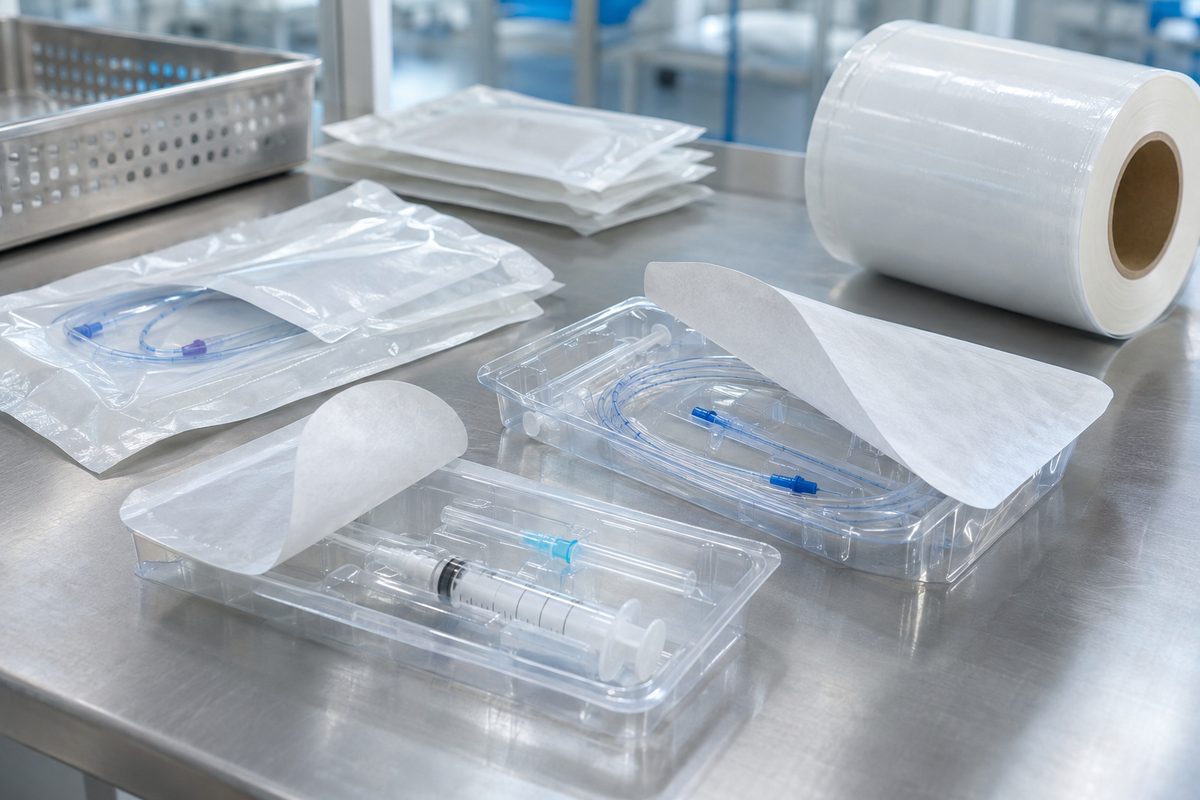
Because radiation penetrates sealed packaging, non-porous formats are possible — foil pouches, PET/PE and PA/PE films and thermoformed blisters with film lids. Porous lids such as coated paper or Tyvek® are also widely used. Kangde Med supplies PET/PE and PA/PE composite films, blister films and coated paper and EO dialysis film pouches that are also suitable for irradiation. Seal strength and integrity must be checked after irradiation — see seal strength testing.
6Choosing between radiation and EO
Radiation suits high-volume, single-use, radiation-stable devices that need fast release; EO suits complex assemblies, electronics and radiation-sensitive polymers. Our overview of medical device sterilization methods compares all options.
7Frequently asked questions
What dose is used for gamma sterilization?
25 kGy is the most common reference dose, but ISO 11137-2 allows lower or higher doses established by validation based on product bioburden.
Is e-beam sterilization as effective as gamma?
Yes, at the same validated dose. The difference is penetration and speed: e-beam is faster but suits lower-density, thinner product configurations.
Does radiation make products radioactive?
No. Gamma, e-beam and X-ray at sterilization energies do not induce radioactivity in the product.
Can paper/film pouches be irradiated?
Most medical-grade paper/film pouches tolerate standard doses, but the specific materials and seals should be tested after irradiation for strength and discoloration.