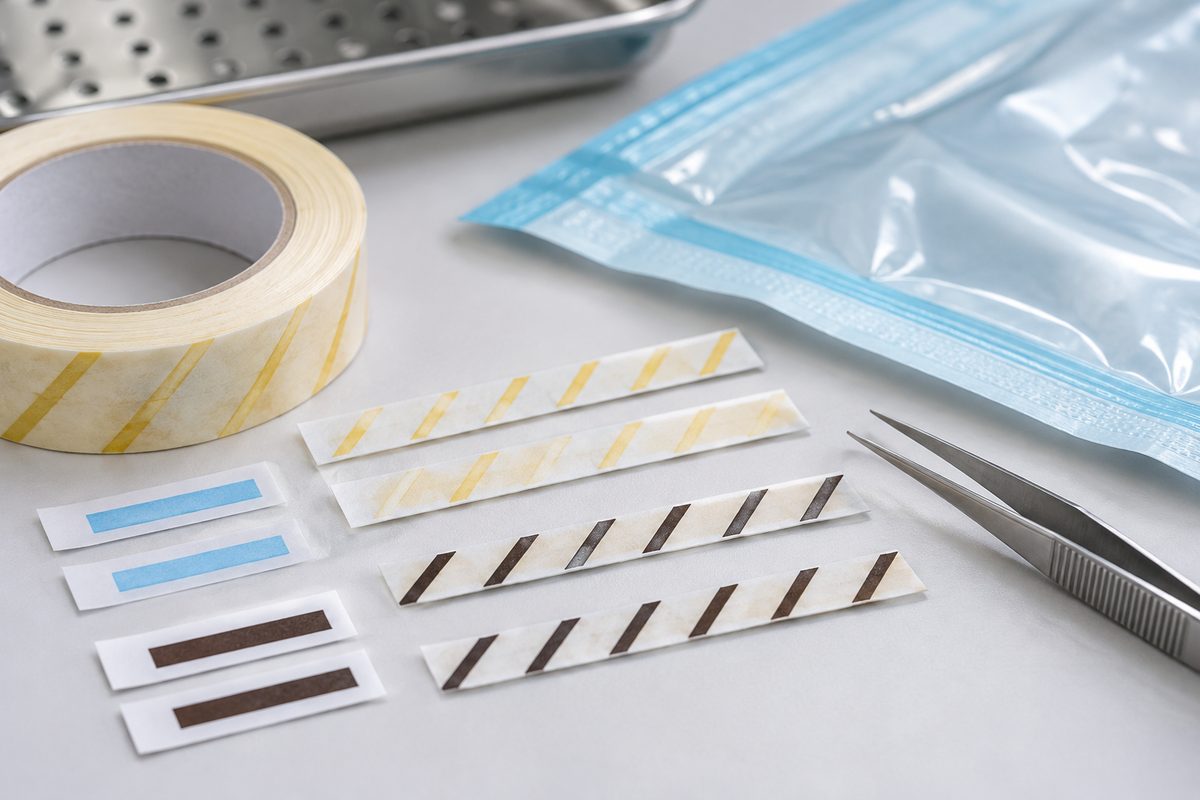
1What does a chemical indicator do?
In chemistry an indicator is any substance that changes visibly in response to a condition. In sterilization, a chemical indicator (CI) shows whether the sterilant — steam, EO, H₂O₂ or formaldehyde — reached it and whether the critical variables (time, temperature, saturated steam or gas concentration, humidity) met the stated values. CIs give an immediate result for every pack, which is why they are used far more often than biological indicators.
2The six ISO 11140-1 types
| Type | Name | Responds to | Example | Where used |
|---|---|---|---|---|
| 1 | Process indicator | Exposure to the process | Steam tape, pouch inks | Outside every pack |
| 2 | Specific-test indicator | A specific test procedure | Bowie-Dick test sheet | Daily air-removal test |
| 3 | Single-variable | One variable (e.g. temperature) | Temperature tubes | Rare today |
| 4 | Multi-variable | Two or more critical variables | Class 4 steam strip, EO strip, plasma strip | Inside packs |
| 5 | Integrating | All critical variables; correlated to BI kill | Class 5 integrating strip | Inside packs, implant loads |
| 6 | Emulating | All critical variables of one specific cycle | Class 6 strip | Inside packs for a defined cycle |
3Class 4 vs Class 5 vs Class 6
- Class 4 is the economical everyday choice: it changes when, for example, 134 °C and adequate exposure time are reached, but its tolerances are wider.
- Class 5 integrators have stated values that track the inactivation curve of *Geobacillus stearothermophilus* spores, so a pass gives much higher confidence; many facilities use them to release loads with implants while the BI incubates.
- Class 6 emulators have very tight tolerances around one cycle (e.g. 134 °C for 3.5 min or 121 °C for 15 min). They fail if any variable is even slightly short — ideal when a facility standardises on one cycle.
4How to place and read internal indicators
- Place the strip in the most challenging location — centre of the tray, between layers, inside lumened sets.
- Do not touch the indicator ink with wet gloves.
- Read at the point of use (or at pack opening) against the reference colour.
- Any fail = do not use; quarantine the load and investigate.
5Chemical vs biological indicators
CIs confirm conditions; biological indicators confirm lethality. Use both — see chemical vs biological indicators and biological indicators and spore testing.
6Sourcing indicator strips
Ask for ISO 11140-1 test reports per type and sterilization method, heavy-metal-free ink declarations, clear reference colours, shelf life and lot traceability. Kangde Med manufactures Type 1, 4, 5 and 6 indicators for steam, EO, H₂O₂ plasma and formaldehyde, with OEM packaging for distributors.
7Frequently asked questions
What is a Class 4 chemical indicator?
A Type 4 multi-variable indicator that responds to two or more critical variables of a sterilization process, such as temperature and time in steam. It is placed inside packs.
What is the difference between Class 5 and Class 6 indicators?
Class 5 integrating indicators respond to all critical variables across a range of cycles and correlate with biological kill; Class 6 emulating indicators are designed for one specific cycle with tighter tolerances.
Are autoclave test strips the same as biological indicators?
No. Autoclave test strips are usually chemical indicators. Biological indicators contain bacterial spores and require incubation.
How often should chemical indicators be used?
A Type 1 indicator on the outside of every pack and an internal Type 4, 5 or 6 indicator inside every pack, every cycle.