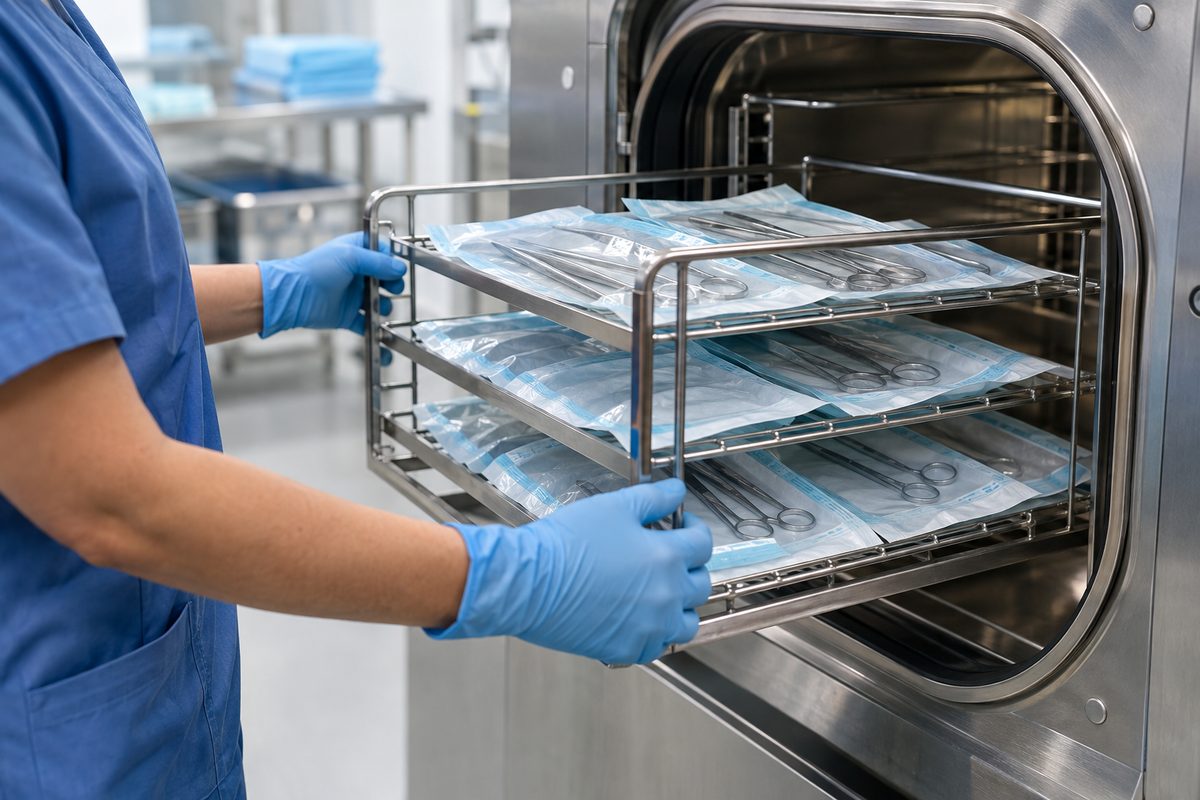
1How each method kills microorganisms
Moist heat — saturated steam condenses on the load, transferring latent heat and water. Proteins coagulate and denature quickly, so lethality is high even at 121 °C.
Dry heat — hot air transfers heat slowly by conduction and convection. Microorganisms die by oxidation and dehydration of cell components, which needs higher temperatures and longer exposure.
2Time and temperature compared
| Parameter | Moist heat (autoclave) | Dry heat (hot-air oven) |
|---|---|---|
| Temperature | 121–134 °C | 160–190 °C |
| Exposure time | 3–30 min | 6 min (rapid forced-air at 190 °C) to 2 h |
| Common cycles | 121 °C/15–30 min; 134 °C/3.5 min | 160 °C/2 h; 170 °C/1 h; 180 °C/30 min |
| Mechanism | Protein coagulation | Oxidation |
| Biological indicator | *Geobacillus stearothermophilus* | *Bacillus atrophaeus* |
| Packaging | Paper/film pouches, reels, wraps, containers | Foil, glass containers, nylon or special dry-heat pouches |
3Advantages and disadvantages
Moist heat (autoclave)
- Fast, inexpensive, non-toxic and highly reliable.
- Penetrates porous loads and textiles.
- Can corrode carbon-steel instruments and dull cutting edges.
- Not suitable for oils, powders or moisture-sensitive items.
Dry heat
- No corrosion; good for sharp instruments, burs, glassware and metal.
- Sterilizes powders and anhydrous oils that steam cannot penetrate.
- Very slow; high temperatures damage plastics, rubber and paper.
- Standard paper/film sterilization pouches are not rated for dry heat — use packaging validated for it.
4Which should you choose?
Use moist heat for the vast majority of surgical and dental instruments, textiles and laboratory media. Choose dry heat only for items the IFU specifies — powders, petroleum-based products, depyrogenation of glassware (typically 250 °C) or some orthodontic and endodontic instruments. Many dental regulators now discourage hot-air ovens because autoclaves offer better validated performance.
5Monitoring both methods
Every load needs an external process indicator and an internal indicator matched to the method; for steam, use steam indicator tape and Class 4 or Class 5 strips. Weekly biological testing applies to both. See our autoclave temperature chart and the steam sterilization guide.
6Frequently asked questions
Is an autoclave dry heat or moist heat?
An autoclave uses moist heat in the form of saturated steam under pressure.
What is the temperature and time for dry heat sterilization?
160 °C for 2 hours, 170 °C for 1 hour or 180 °C for 30 minutes, timed after the whole load reaches temperature.
Why is moist heat more effective than dry heat?
Water accelerates protein coagulation and condensing steam transfers heat far faster than hot air, so moist heat kills microorganisms at lower temperatures in shorter times.
Can I use sterilization pouches in a dry heat sterilizer?
Standard paper/film steam and EO pouches are not designed for 160–190 °C. Use nylon pouches, foil or containers validated for dry heat.