1What is an autoclave?
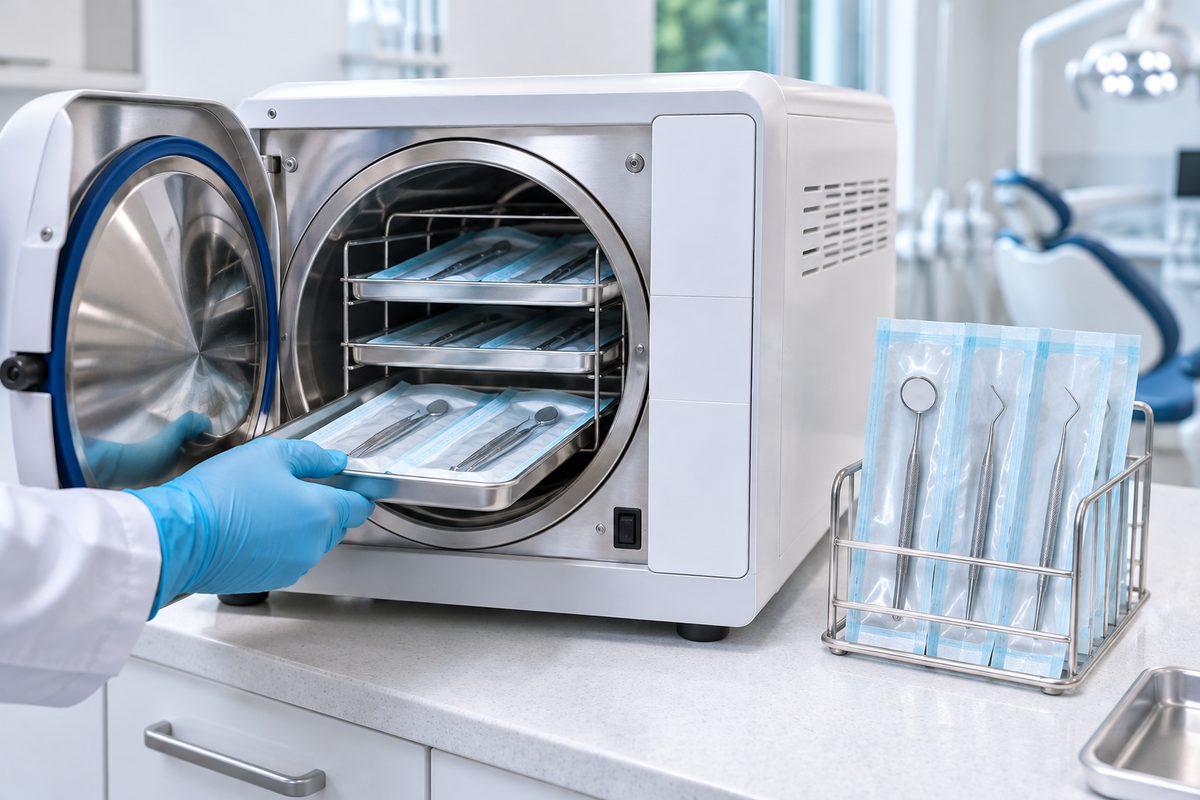
"Autoclave" comes from Greek *auto* (self) and Latin *clavis* (key) — a self-locking vessel. An autoclave, or steam sterilizer, is a sealed chamber in which saturated steam under pressure is held at a set temperature for a set time. It is the most widely used sterilization method in hospitals, dental clinics, laboratories and the pharmaceutical industry because it is fast, non-toxic, inexpensive and highly lethal to spores.
"Autoclavable" means an item or material can withstand repeated steam cycles at sterilizing temperature without damage — stainless steel instruments, borosilicate glass, polypropylene and most medical textiles.
2How does an autoclave kill microorganisms?
At sea level water boils at 100 °C. Raising the pressure to about 1 bar (15 psi) above atmospheric raises the boiling point to 121 °C; about 2.1 bar (30 psi) gives 134 °C. When saturated steam meets the cooler surface of an instrument it condenses, releasing roughly 2,200 kJ of latent heat per kilogram and wetting the surface. That moist heat denatures and coagulates proteins and enzymes, killing vegetative cells and spores far faster than dry heat at the same temperature.
So does an autoclave heat things up with steam? Yes — and the condensation is precisely what makes it lethal. That is also why air removal matters: an air pocket insulates the surface and stops condensation.
3Gravity-displacement vs pre-vacuum autoclaves
| Feature | Gravity displacement | Pre-vacuum / dynamic air removal |
|---|---|---|
| Air removal | Steam enters at top, pushes heavier air out of the drain | Vacuum pump or steam-flush pressure pulses remove air |
| Typical cycle | 121 °C for 30 min (wrapped) | 132 °C for 4 min or 134 °C for 3–3.5 min |
| Total cycle time | 45–75 min with drying | 30–60 min with drying |
| Best loads | Liquids, unwrapped instruments, lab waste | Wrapped sets, textiles, hollow and porous items |
| Daily air-removal test | Not required | Bowie-Dick test every day |
Steam-flush pressure-pulse (SFPP) sterilizers use alternating steam injections and pressure releases instead of a deep vacuum. European benchtop sterilizers are graded as Class B, N and S under EN 13060 — see our dental autoclave guide.
4The autoclave sterilization process step by step
- Conditioning — air removal and heating of the load.
- Exposure (sterilization hold) — the load is held at the set temperature, e.g. 134 °C for 3.5 minutes.
- Exhaust — steam is released and pressure returns to atmospheric.
- Drying — a vacuum or heated jacket removes condensate so packs leave dry.
For exact time-temperature-pressure combinations read autoclave temperature, time and pressure.
5How to use an autoclave correctly
- Clean and dry every instrument first; organic soil and water droplets cause failures.
- Package in sterilization pouches or reels — paper side to paper side, never film to film, so steam can penetrate and condensate can escape.
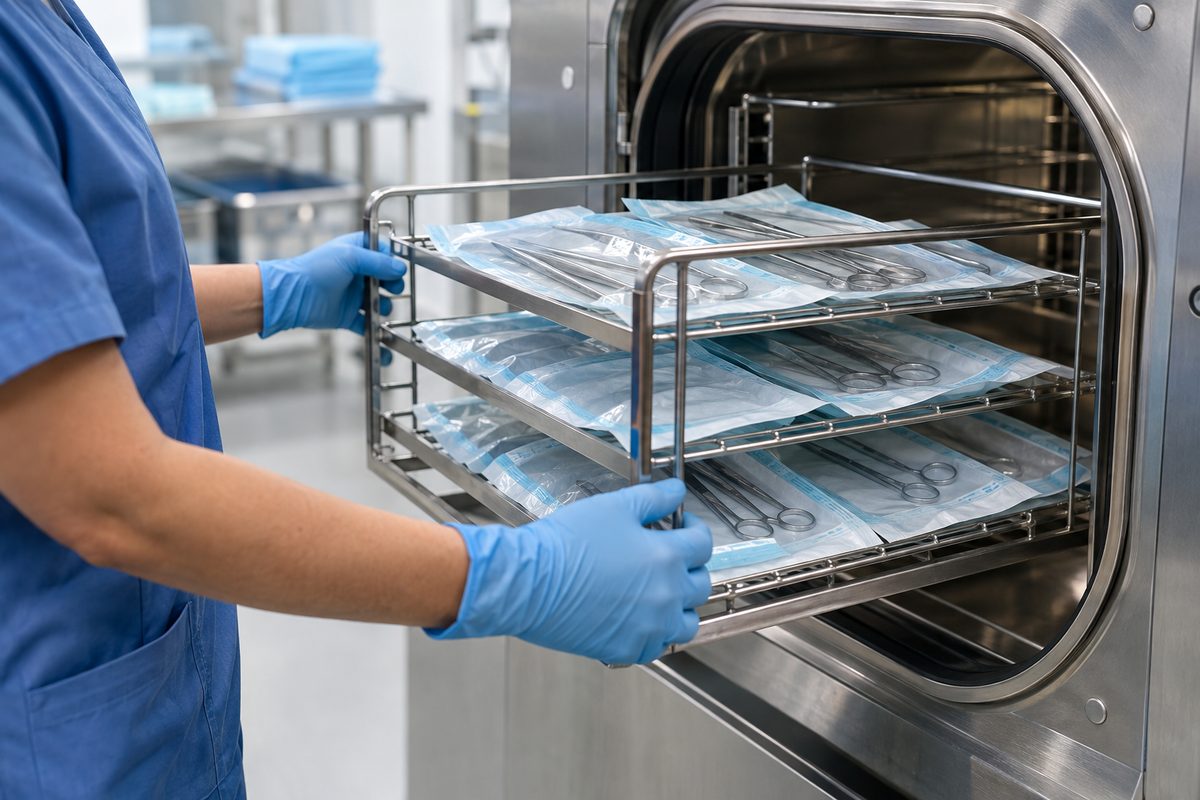
- Open hinged instruments; place pouches on edge in racks rather than stacking them flat.
- Do not overload — leave space for steam circulation.
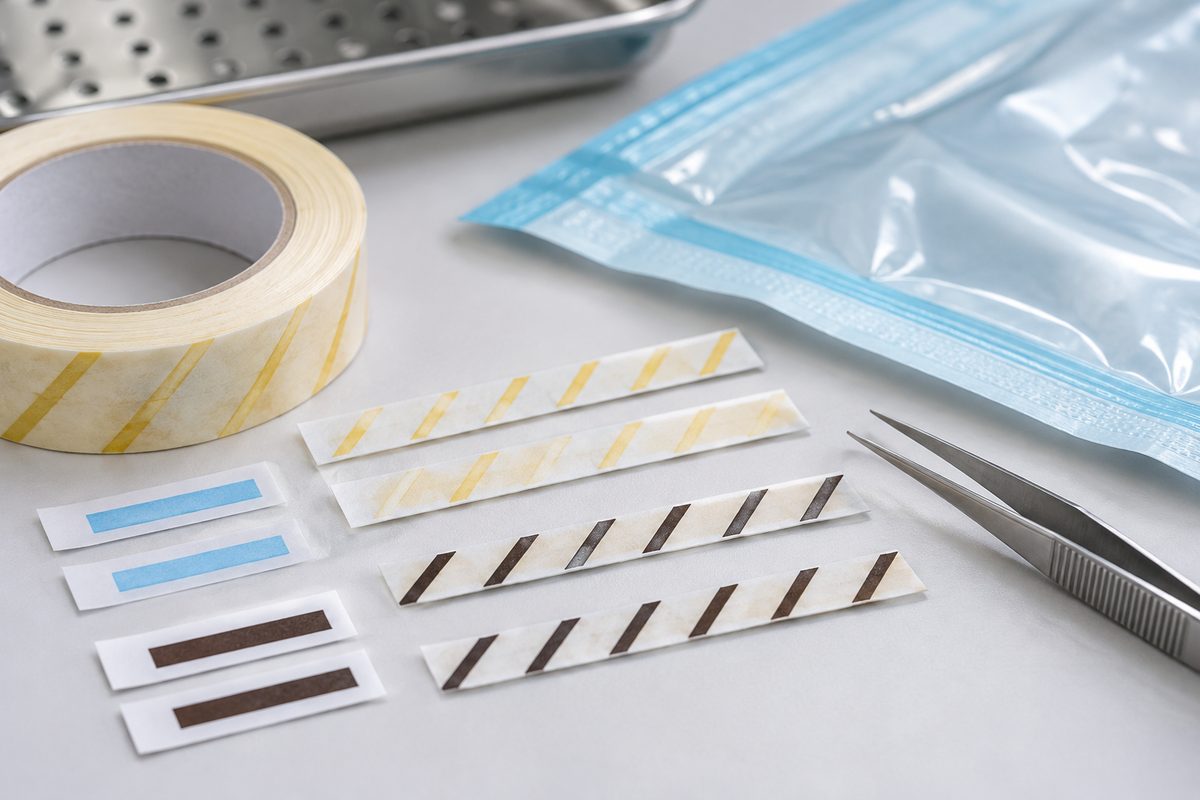
- Put a Type 1 steam indicator tape or pouch indicator on the outside and a Class 4 or Class 5 integrating indicator inside each pack.
- Let packs cool and dry in the rack before handling.
6Monitoring every cycle
Check the printout for time, temperature and pressure; read the chemical indicators before releasing each pack; run a biological indicator (spore test) at least weekly and in every load containing implants; and in pre-vacuum sterilizers run the Bowie-Dick test each morning.
7Industrial and medical autoclave uses
Beyond hospitals, autoclaves sterilize culture media and waste in laboratories, components and garments in pharmaceutical cleanrooms, and tattoo and beauty-salon tools. The same consumables apply: indicator tape on every load and indicator strips where penetration must be proven.
8Frequently asked questions
What does an autoclave do?
It sterilizes instruments and materials by exposing them to saturated steam under pressure, typically at 121 °C or 134 °C, for a defined time, killing all microorganisms including spores.
Is an autoclave moist heat or dry heat?
An autoclave uses moist heat (saturated steam). Dry-heat sterilizers use hot air at 160–180 °C and take much longer.
How long does an autoclave cycle take?
The sterilization hold is 3–30 minutes depending on temperature and load, but a full cycle including heating, air removal and drying usually takes 30–75 minutes.
What cannot be autoclaved?
Heat-sensitive plastics, many electronics, oils and powders (steam cannot penetrate them), and corrosive or flammable chemicals. Use low-temperature or dry-heat methods for these.
Why do packs come out wet?
Usually from overloading, film-to-film pouch placement, cold or heavy metal loads, wet steam or a drying-phase fault. Wet packs must be treated as non-sterile and reprocessed.